By Catherine Owen Koning, Originally Published in The Monadnock Shopper News, Green Monadnock column, March 2026.
Amidst the daily onslaught of alarming news, one big concern continues to lurk in the background – climate change. The problem is real (global temperature IS increasing, beyond anything we have seen in the last 10,000 years), it IS the result of human activity (increased production of planet warming gases carbon dioxide, methane, fluorinated gases and nitrous oxide), and the consequences for all life on earth will be devastating (30 inches of sea level rise, half a million deaths from extreme heat, loss of one quarter of all species, etc.). Recent studies show that if we don’t achieve this by 2030, the planet is likely to go past certain “tipping points”, like the melting of land-based ice in Antarctica – and there’s no going back after that – it will be “hothouse planet” for a very long time.
The good news is that we have the technology to SOLVE THIS PROBLEM! But we have to do it FAST. We have to reduce our planet-warming gases by 50 billion tons every year until 2030. So, we have a little math problem.
At the heart of the situation: we need to reduce or eliminate the burning of fossil fuels, coal, oil, gasoline, and natural gas. Extracting, transporting and burning these fuels produce carbon dioxide, the most common planet warming gas, and nitrous oxide and methane. The overall strategy to avoid hothouse planet is to conserve energy, use clean energy sources to produce electricity, then to electrify everything: Heating, transportation, cooking, etc. Then, use new technologies for the most harmful industrial processes.
How do we make it add up? Here’s the math. Estimates come from Project Drawdown, a private non-profit group of scientists who use tons of data to estimate the costs and benefits of different actions. For each one, they are assuming a certain increase in each category; shown here is the upper end (most optimistic) of their range of estimates. They recommend solutions based on readiness, effectiveness, availability and cost, etc.
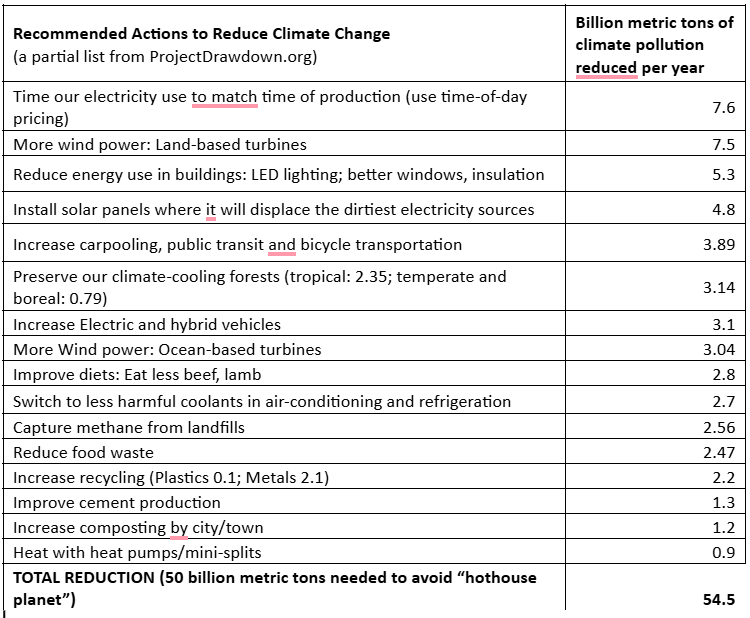
So, it is possible! Remember these are optimistic assumptions, however.
A key point is that although every person can do SOME of these actions on their own, a lot of them require COLLECTIVE action – coming together to make changes. This isn’t easy, especially now when so many people are upset with each other. Many of the solutions need leadership from business, also. It will also cost a lot of money – several trillion dollars. There are many ways to make all of this happen, one of which is carbon pricing – explained in John Kondos earlier column.
We have to come together, quickly, to save ourselves. Fortunately, many of these changes will have a lot of added benefits: Less air pollution means less lung disease, for example. More electricity from solar, and more electric vehicles, means more control over our own lives – we don’t have to worry about the price of oil or who has to die to get it for us. Protecting our forests maintains our own tourism-based economy and our freedom to enjoy wildlife, hiking, hunting and fishing in our beautiful state.
But we have to do it FAST, or it will be too late.
Catherine Owen Koning is a Professor of Environmental Science and Policy at Franklin Pierce University in Rindge NH. She is also a board member of the Monadnock Sustainability Hub, which strengthens the sustainability and resilience of our region by working collaboratively to reduce climate pollution and reach 100% clean energy.